“When You Have a Winner, Press the Bet”: Legendary Investor Eric Sprott’s 2026 Silver Portfolio – 9 companies
Eric Sprott’s High-Risk High-Reward Silver Plays

“When you have a winner, press the bet.”
— Eric Sprott
Not financial, investment, legal, or tax advice. Please read our full Disclaimer on the Disclaimer page. Accessible via the provided link and via the homepage menu. Continued reading constitutes your agreement to its terms.
The legendary gold and silver investor and self-made billionaire Eric Sprott shared his thoughts in an interview in June 2026 (see in full further below) on the gold and silver market, and on some silver and gold companies that he owns.
Eric Sprott delivers a characteristically blunt and experienced assessment of the current state of the gold and silver markets. While acknowledging the violent recent gold and silver sell-offs, he maintains a strong long-term bullish conviction, framing the pullback as a classic market manipulation tactic by banks caught on the wrong side of their short positions. He views the weakness in the broader economy, particularly in housing, private credit, and now potentially in the AI sector, as the foundation for a significant flight to safety into precious metals and mining stocks.
This article is based on a recent interview with Eric Sprott (June 2026) and his 2026 SEC filings covering his purchases in the U.S. Eric Sprott is Canadian. Any purchases in Canada that he did not mention in his interview would not be covered by the SEC filings and thus are not included in this article.
Why is it so helpful to understand the investments of legendary mining investors like Eric Sprott? Because once you go beyond the major senior mining companies and enter the territory of junior mining and exploration companies, as Rick Rule paraphrased, “about 90% are worth nothing.”
But at the same time, the exploration and junior mining space is where the 200x+ opportunities are hiding.
Focusing on companies pre-selected by legendary investors like Eric Sprott doesn’t guarantee winners (he makes bad picks too), but the probability of being saddled with a loser is a lot less, and those investments are a great lead list for one’s own investment analysis and picks.
Coming back to Eric Sprott. He noted that “almost every day, somebody’s taken a billion dollars’ worth of gold out of COMEX every day this month” (25:52).
Paper markets trade digital promises. Physical markets trade real goods. Nowhere is this divide more critical than in gold and silver. While paper contracts fluctuate wildly, physical metal is steadily draining from CME/COMEX vaults.
What is CME/COMEX? CME/COMEX is the main exchange where traders buy and sell paper contracts for gold and silver. These contracts are basically IOUs—promises to deliver metal at a future date. Most traders never take delivery. They just bet on prices and settle in cash. Think of it like a casino where people gamble on gold prices without ever touching the real thing.
Why this matters in simple terms: Imagine CME/COMEX as a ticket office that keeps selling promises for a concert, but the actual tickets are disappearing from the safe. People are grabbing the real tickets and walking out. The vaults are emptying. But the paper market still acts like there’s plenty of metal available. That can’t last forever. When paper traders eventually realize there isn’t enough physical metal to back up all their promises, prices will have to shoot up. For investors, this divergence signals that the real asset—physical gold and silver—is becoming scarce while paper prices stay artificially low. That gap is a buying opportunity.
In a different interview (recorded July 1, 2026), legendary investor Rick Rule shares that bullish sentiment. He said, “I believe that 10 years from now the gold price will be much higher, at least in nominal terms than it is today. So I’m a structural buyer. As a structural buyer, lower prices suit me. The truth is that if you took a $1,000 move in gold either direction, $1,000 higher, I wouldn’t be a seller. $1,000 lower, I’d be a big buyer.”
Chapter 1: The Big January 2026 Silver Drop – Manipulation or the Market?
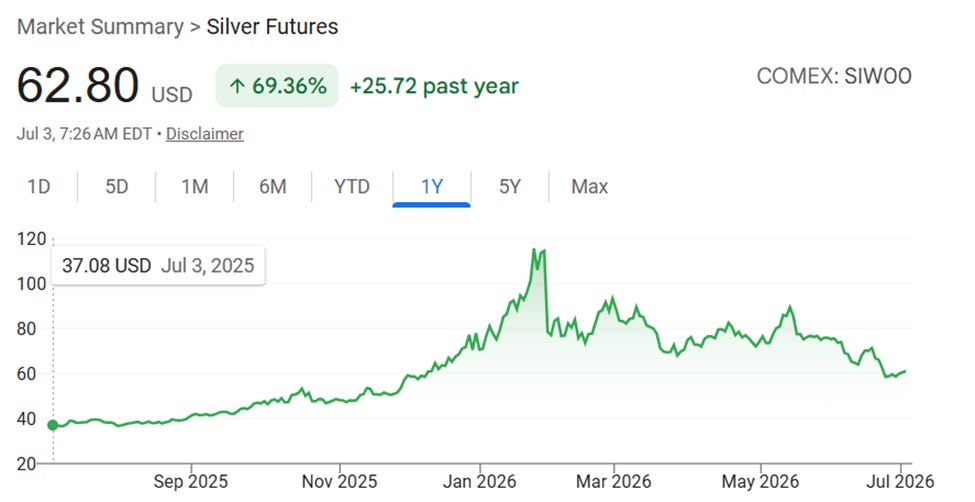
The first major topic Sprott addresses is the violent crash in gold and silver prices in late January 2026, when silver fell from around $114/oz on January 29, 2026, to about $78/oz on January 30, 2026. He is not shy about his opinion: he believes this was not a normal market move. Instead, he thinks it was a direct case of manipulation by the big commercial banks.
1 Year Silver Price History
Here is his logic. The banks were heavily “short” silver. This means they had bet that the price would go down. But silver had been going up, so they were losing billions of dollars. To make matters worse, a huge number of options contracts were about to expire. If silver closed at a high price on that day, the banks would have faced absolutely massive losses. So, what happened? In just 30 hours, the price of silver was knocked down a lot.
As Eric Sprott puts it, “That’s impossible. The impossible happened in 30 hours.” (6:19)
He points out that the CME/COMEX helped this process by raising margin requirements. This forces traders who are already losing money to come up with even more cash, which often forces them to sell, pushing the price down even further.
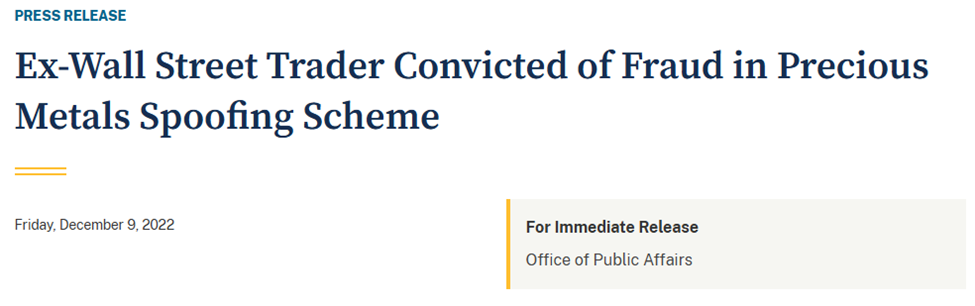
Eric Sprott also reminds us that people from big banks have actually gone to jail in the past for manipulating the silver price, so this kind of activity is not just a conspiracy theory.
“We know that people have gone to jail for manipulating the price of silver. People from very big banking institutions in the United States have gone to jail.” (2:35)
If you think that is an exaggeration, here are some examples:
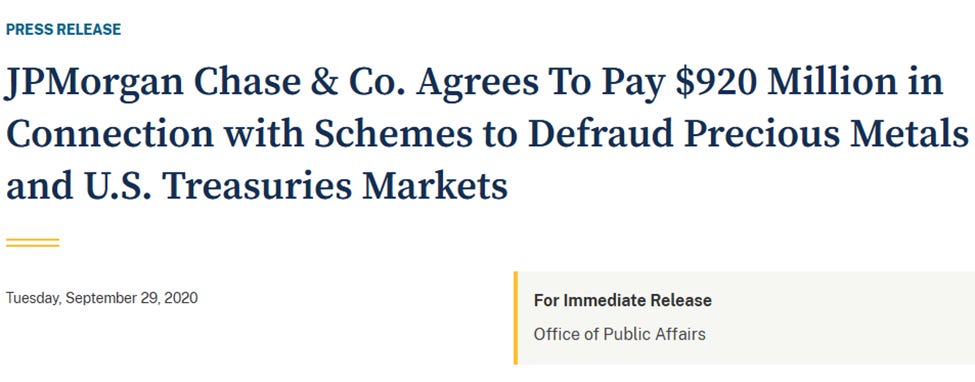
Eric Sprott’s message is clear: while the drop was violent and scary, it was an artificial event driven by desperate banks, not a sign that the bull market is over.
And, as we might add, the current silver price of around $62/oz, while lower than its high in January 2026, is still a lot higher than the silver price from one year ago of around $37/oz.
1 Year Gold Price History
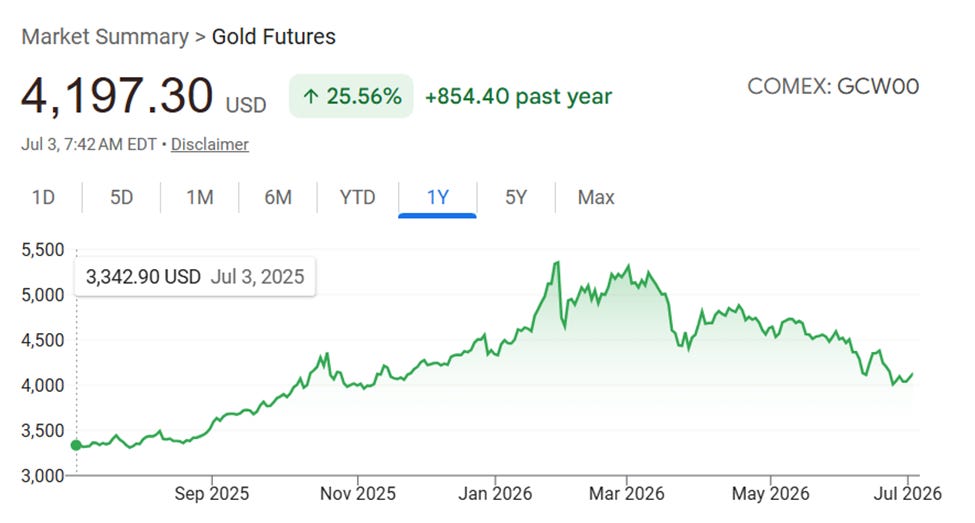
And in a completely “unrelated move” on the exact same day, gold also came down hard on January 30, 2026, from $5,354/oz on January 29, 2026, to $4,745/oz on January 30, 2026.
As Eric Sprott pointed out, “I could get mad at myself for playing in a game where you know it’s manipulated” (5:25). While that is certainly so, the precious metals market made Eric Sprott a billionaire. No pain, no gain.
As Jim Rogers famously said (as recalled by James Rickards in a recent interview), commodities are not for the faint-hearted. Jim Rogers said:
“In commodities trading, nothing goes to the moon without a 50% drawdown along the way. And if you’re not ready for that, you’re in the wrong market. Just—you know—get used to it. That’s how commodities trade.”
The Fringe Finance Report take: There are certain asset classes like gold, silver, and oil that have political relevance. Politicians and central banks need the trust of ordinary people in fiat currency (the US dollar, British pound, Japanese yen), even though everyone knows they are backed by nothing and lose purchasing power over time. One way to do that is to scare ordinary investors away from gold and silver by occasionally crashing their prices, since those investors just follow the headlines and not the long-term trend.
Chapter 2: Why the Gold & Silver Bullish Case is Still Rock Solid
Even though gold and silver prices got beaten down, Eric Sprott insists that all the fundamental reasons to own gold and silver are still completely intact. In fact, he argues the case is stronger than ever. He starts by giving some perspective.
While gold and silver have fallen from their peaks, they are still much higher than they were just one year ago. He reminds everyone that silver is not just a precious metal; it is a crucial industrial metal:
“We all know what the fundamental picture in gold and silver is, particularly silver because it’s an industrial product. You can see the uses and the demand for it [silver] and the shortages for the last five years and now a sixth year.” (2:19)
The biggest buyers of gold and silver are not American investors, but central banks and people in China and India. He shares a stunning fact:
“Gold imports into China... I think there were 164 tons in May. That’s 2,000 tons annually. We only have 4,000 tons [gold production annually].” (16:43)
If they keep that pace, they would buy about half of all the gold mined in the entire world each year. He also brings up a historical fact that when gold and silver were used as real money, the ratio was 15 ounces of silver to one ounce of gold.
He said:
“When silver and gold were currencies, silver traded a 15 to 1 ratio to gold. When gold was at 4500, silver should have been 300. But it has been suppressed for all these 50 odd years by banks who’ve been short the whole time.” (5:46)
The only reason silver is not there, in his view, is that the banks have been suppressing its price for decades. He has full confidence that the fundamentals will eventually win out and push prices much higher:
“I stand by the case that gold and silver will bounce back further for all the same fundamental reason.” (4:26)
Beyond what Eric Sprott mentioned, there is also the factor of the relentless expansion of the money supply.
The famous macro analyst Lyn Alden said:
“As long-term readers know, one of my favorite charts for gold is to compare the price of gold to the growth of broad money supply per capita. This works for any major currency, and I happen to track it in U.S. dollars, which is perhaps the best comparison because both gold and the dollar are traded worldwide. The idea behind this ratio is that, over time, currencies inflate and devalue vs gold at various rates, while gold holds its purchasing power over the long term.”
Source: https://www.lynalden.com/reasons-to-buy-gold/
And as one can see based on data published by the Fed, the money supply has increased dramatically, from around $4.0 trillion in the year 2000 to about $22.0 trillion in the year 2026.
M2 (Money Supply) 2000 to 2026
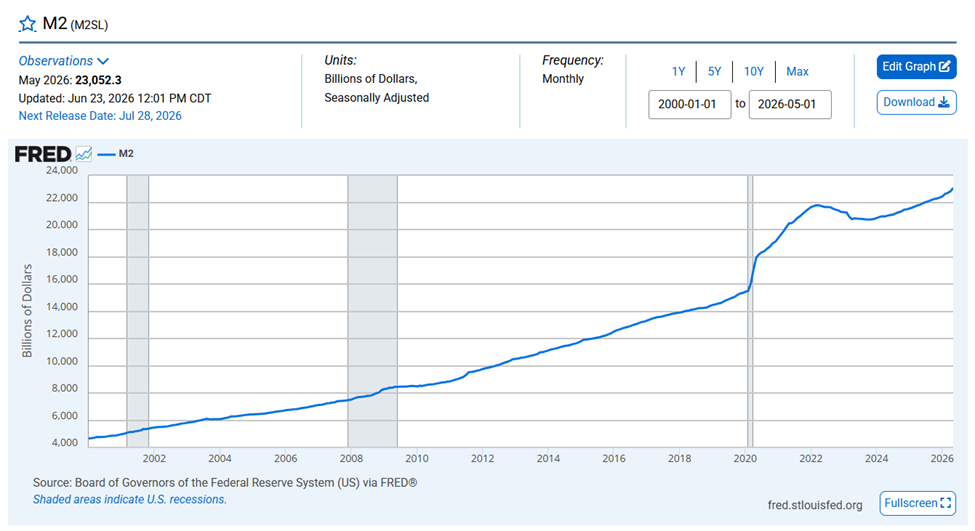
Source: https://fred.stlouisfed.org/series/M2SL
The Fed doesn’t provide M2 per capita (Lyn Alden’s metric), but we know that the U.S. population in 2000 was around 282 million and in 2026 around 346 million. So while the money supply increased by 5.5x, the population only increased by 1.2x. It’s no wonder the gold price increased from $279/oz in 2000 to about $4,182/oz in 2026.
The geopolitical factor also cannot be ignored. The freezing of Russian central bank assets in 2022 sent a clear signal to nations around the world: U.S. Treasury securities are only yours as long as the U.S. continues to like you. This realization has led central banks globally to increase their gold purchases—an asset that cannot be sanctioned—relative to U.S. Treasuries, which can be and have been sanctioned. This even includes friendly NATO allies like Poland.
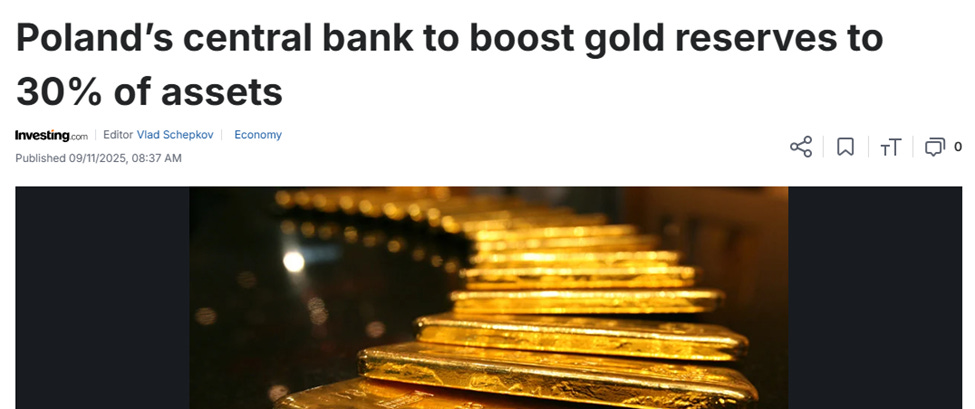
Graph: A record high number of central bankers expect their gold reserves to increase
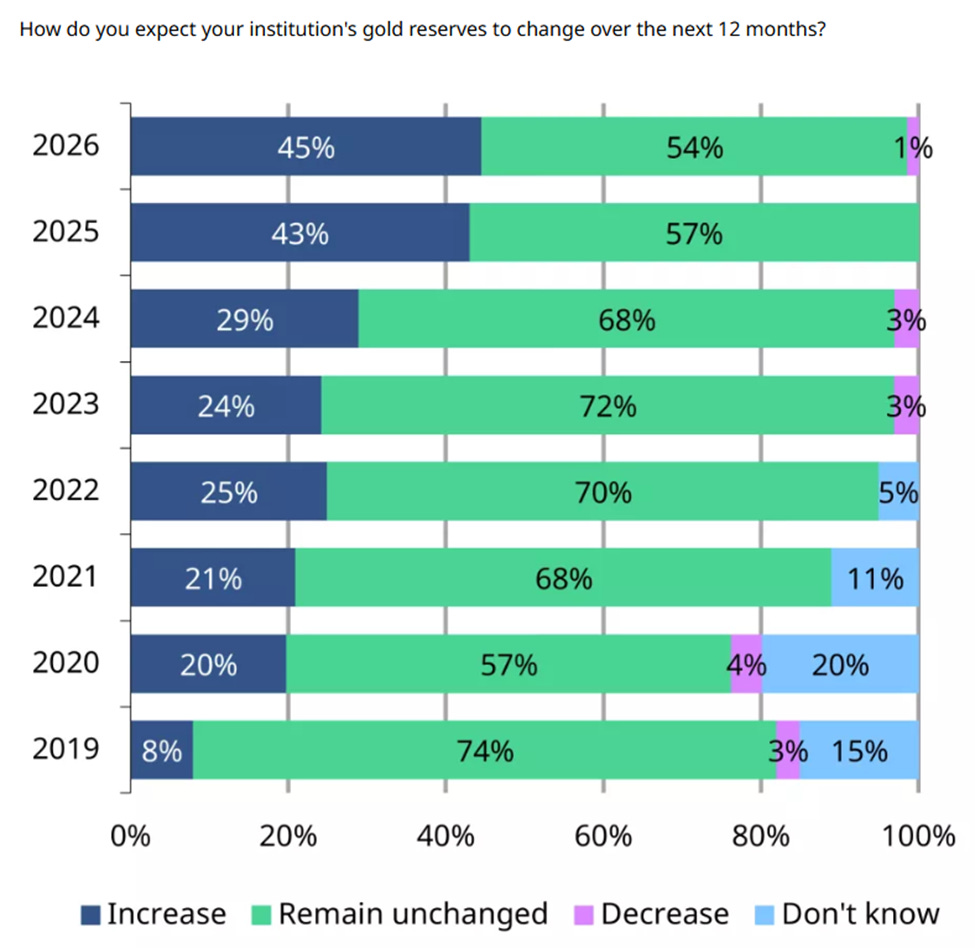
As the survey above shows, a record number of central banks (45%) in 2026 plan to increase their institutional gold reserves. Compare that to only 21% in 2021—the year before the Russia sanctions.
The Fringe Finance Report take: Decisions have consequences, and weaponizing the U.S. dollar to such an extreme degree as in 2022 has extremely bad consequences. Bad for the U.S.—not today, not tomorrow, but long-term. Good for gold investors.
Chapter 3: A Junior Silver Producer Owned by Eric Sprott – The Americas Gold and Silver Corp. (USAS) Teaser

Americas Gold and Silver Corporation (USAS) is a Toronto-based mining company. Despite the word “Gold” in its name, the company derives nearly all of its revenue from silver, targeting over 80% from that metal.
Currently, the company operates two active mines: the Galena Complex in Idaho, USA, and the San Rafael Mine in Sinaloa, Mexico. The company is also pursuing growth initiatives, though it faces challenges at its Mexican operation, which are detailed further below.
According to his SEC Schedule 13D filing dated June 12, 2026, Eric Sprott purchased 7,956,696 shares of Americas Gold and Silver Corp. on June 10 at an average price of just $5.57 per share. He deployed over $44 million in a single transaction, bringing his total beneficial ownership to 48,010,636 shares—a significant 14.33% of the entire company.
In other words, while the mainstream media was wringing its hands over falling gold and silver prices, legendary investor Eric Sprott saw the opportunity and increased his position in this miner.
Americas Gold and Silver Corporation (USAS) – 1 Year Stock Price History
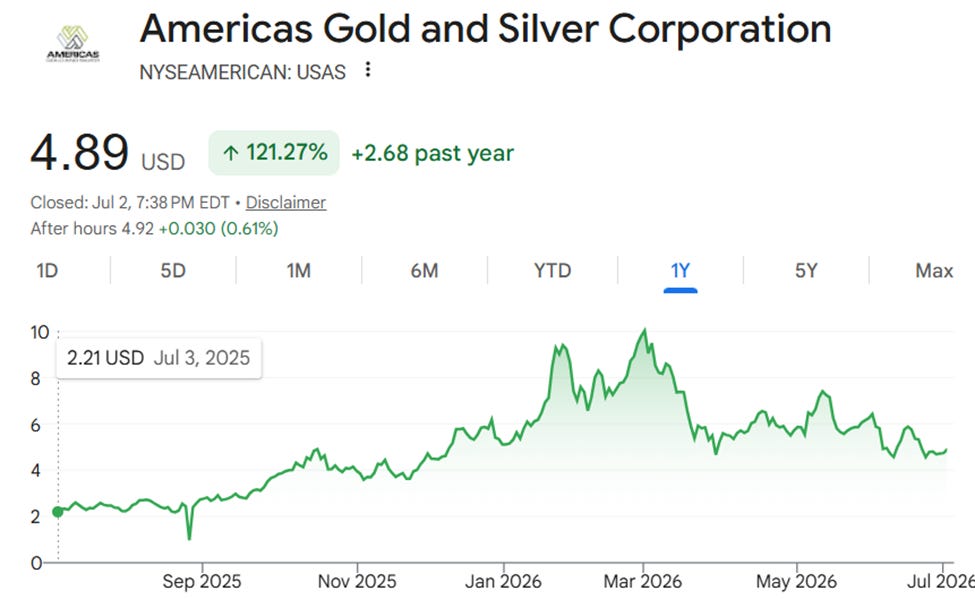
As the price chart above shows, USAS is currently trading at $4.89. That is less than what Eric Sprott paid for it in June. The company hit its all-time high on March 2, 2026, with a stock price of $10.03. A year ago, the company was trading at $2.21.
(The full Americas Gold and Silver Corporation analysis – with all the risks and homework – is in Chapter 5.)
Beyond USAS, Sprott also has an even larger position in another company - his largest holding. The Fringe Finance Report previously wrote about that company on November 2, 2025, in an article called “Legendary Investor Eric Sprott’s Next 200x US-based Gold & Silver Play.”

Eric Sprott has bought even more shares of this company in 2026. He made at least 9 separate purchases during the first half of the year (Q1 and Q2). He is clearly very bullish on this company – his single largest investment.
This company is covered in more detail in Chapter 5.
In the following sections we will cover the following:
Chapter 4: Eric Sprott’s Core Portfolio (Low to Mid Risk) – 4 Companies
Chapter 5: Eric Sprott’s Speculative Edge (High Risk, High Reward) – 5 Companies
Chapter 6: Summary & Source Attribution