Silver Miners with Liquid Options for Extra Leverage
Silver Bulls: Leverage Up with Miners and Call Options on Miners

“In the short run, the market is a voting machine, but in the long run, it is a weighing machine.”
— Benjamin Graham (often quoted by Warren Buffett)
Not financial, investment, legal, or tax advice. Please read our full Disclaimer on the Disclaimer page. Accessible via the provided link and via the homepage menu. Continued reading constitutes your agreement to its terms.
Back when the Concorde was still flying, if you urgently needed to get from New York to London, nothing beat it. The Concorde could cut your travel time from around nine hours down to about three. It was perfect if getting to London quickly really mattered. But if you didn’t need to be in London, then this question does not even matter—whether you flew commercial or hopped on the Concorde—since your destination is different.
Silver miners work in a similar way. If you’re bullish on silver for the long term, miners offer a leveraged way to play that view. But if you’re bearish on silver, then miners simply don’t make sense.

For those who are bullish, miners—from large producers to small, pre-revenue exploration companies—can be an excellent tool. And if you’re comfortable with options trading, buying long-dated out-of-the-money (OTM) call options can add even more leverage on top of that. Just remember: options are complex, they expire, and they can go to zero.
Personally, I’m very bullish on silver, even after the price swings we saw at the end of January 2026. As an experienced finance professional, I’m also very comfortable using options. As of February 2026, the longest-dated exchange-traded call options on silver miners expire in January 2028.
Why go for options that far out? Because if you don’t sell or exercise before expiration, your options become worthless—and I’d rather give myself plenty of time. Like other silver bulls, including legendary investor Eric Sprott, I believe in the long-term story for silver. But as the January 2026 volatility showed, anything can happen. Having leverage on leverage—call options on silver miners—is aggressive enough for me without adding the pressure of a short timeline.
Chapter 1: Are You Bullish or Bearish on Silver?
As mentioned above, it all starts with your perspective on silver. Will silver price continue to go up, as many legendary investors believe, or will it go down again, as it has happened before in the history of silver prices?
I can’t emphasize enough how important this point is. If you are bearish on silver, then leveraged investment in silver, like buying silver miners—or even more leveraged, buying long-dated OTM call options on silver miners—makes no sense.
So, let’s step back and see what the cases are for and against silver. And in the spirit of full disclosure, so that you know where I am coming from, I am not only bullish on silver; I am very bullish on silver (and gold) and own miners and call options on miners.
The Case Against Silver
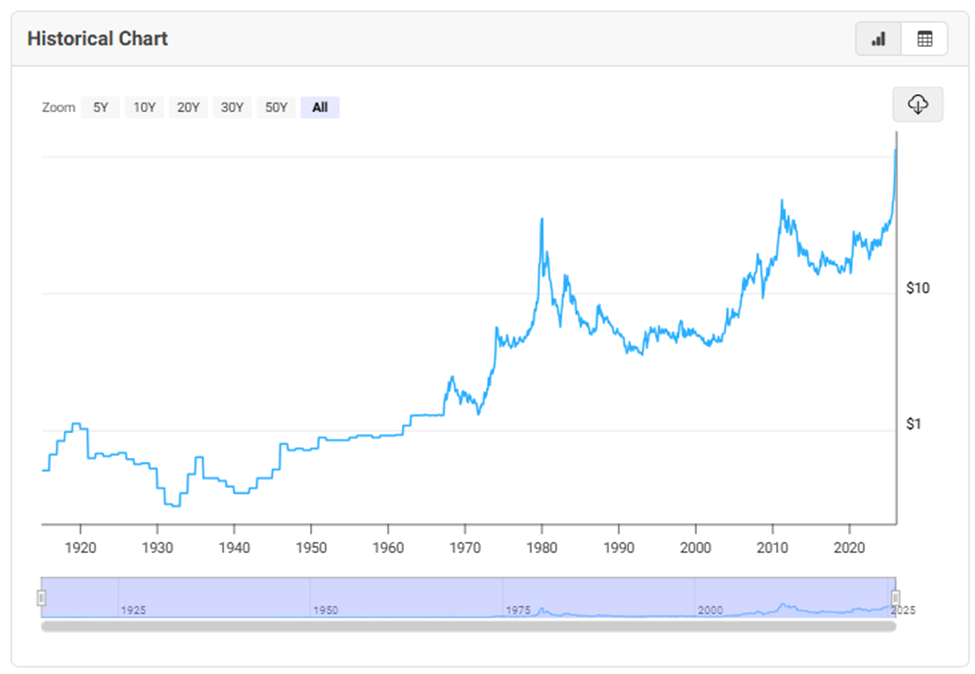
The case against silver would say that this feels like déjà vu—a repeat of past silver manias. We saw one in the early 1980s when the Hunt brothers tried and failed to corner the silver market, and another around 2010 after the subprime crisis, when easy money from the Fed pushed inflation fears and sent silver soaring. Both times, prices hit spectacular highs—only to crash and stay depressed for years afterward.
Now we’re seeing a similar setup again, with silver climbing toward a new peak in late January 2026 near $115. If history rhymes, we can expect another sharp drop followed by a long stretch of weak prices. And it did crash down to about $73 in mid-February 2026, although it recovered somewhat. As of Feb. 26, 2026, it is trading at around $86. Might it go back to around $30, where it was in January 2025—just about a year ago?
From that perspective, piling into silver or silver-mining stocks doesn’t look appealing right now—unless, of course, one’s strategy is to profit on the downside with long-dated puts.
Silver Prices - 100 Year Historical Chart
Source: https://www.macrotrends.net/1470/historical-silver-prices-100-year-chart
The Case For Silver
The famous quote “In the short run, the market is a voting machine, but in the long run, it is a weighing machine,” mentioned at the beginning of the article, is a reminder that while in the short term, investor sentiment may prevail, in the long term, the stock price will reflect economic reality.
That means if you look at the stock or silver price history as a reason for or against silver, you will miss the big picture. And the 800‑pound elephant in the room is the persistent silver supply shortfall since 2021. For a while, this shortfall could be managed with existing reserves, but those are coming to an end.
Think of it as having an income gap in your personal budget. Say since 2021 you made the real median income after tax of roughly $70K per year. But at the same time, you spent $80K per year. For a while you could make up the gap with loans and credit cards, but eventually the day of reckoning approaches (when you run out of credit).
That is what is going on with silver. The silver reserves are coming to an end.
The Fringe Finance Report covered the global silver supply and demand situation in great detail back in July 2025 in the article called “Silver Boom: Just Getting Started. Supply, Demand & Investment Opportunities.”

Beyond this 800‑pound gorilla of a supply shortage, a few other factors have also contributed to rising silver prices.
Rise of a Multipolar World — From the early 1990s (after the Soviet collapse) until recently, the U.S. stood alone as the global superpower. Now, even U.S. leaders admit we’re in a multipolar era, with China emerging as a major power. Sure, headlines peddle hopeful tales of China’s downfall, but the data tell a different story: China’s industrial output is double that of the U.S. and exceeds the combined output of the U.S. and Europe. Every country has challenges (ours included), but banking on a rival’s collapse is just wishful thinking.
The Game-Changer: Global Price Discovery — For decades, the U.S. (COMEX) and U.K. (LBMA) exchanges set silver prices, often through “paper” manipulation—cash-settled futures that big players could game without physical delivery. (JP Morgan paid a record $920 million fine in 2020 for exactly that.) Now, China’s Shanghai exchange—focused on physical settlement—has risen as a rival hub, making such manipulation far more difficult.
National Security on the Line — China kicked off 2026 with new export controls on silver, limiting shipments to licensed firms only. Meanwhile, the U.S. officially listed silver as a critical mineral for the first time in 2025. These moves underscore how high the stakes have become.
So, back to the core question: which story do you believe? Is this another fleeting bubble like those of the 1980s or 2010—or the start of a new era of higher prices (with the usual ups and downs)? Heavyweights like Eric Sprott, Jim Rogers, and Rick Rule—as well as The Fringe Finance Report—are betting on silver’s future. Ultimately, that’s for you, the investor, to decide.
If you’re bearish on silver, this may be where you exit.
But if you share my bullish outlook (and I could be wrong) and want leveraged exposure to silver—to make the most of the coming rally—let’s dig deeper.
Chapter 2: Why Silver Miners Beat Silver for Bullish Investors
Let’s rewind to 2025 for a quick thought experiment. Back then, silver was sitting at roughly $40 an ounce. On average, mining companies spent about $20 per ounce to dig it out of the ground, refine it, and get it ready for the market. That means miners cleared about $20 in profit for every ounce they sold — not bad.
Now, let’s imagine silver prices double to $80 an ounce. Investors who bought physical silver are thrilled — their holdings have doubled in value. But here’s where it gets interesting: for silver miners, the story is even better.
Their costs don’t automatically double. They’re still spending around $20 to produce that same ounce of silver. So at $80 an ounce, their profit margin jumps to $60 — triple what it was before.
That’s the beauty of leverage in mining stocks. When the price of silver climbs, the profits of mining companies grow much faster than the metal’s price itself. More profit per ounce typically leads to stronger earnings, and when earnings rise, share prices tend to follow.
This is why many bullish investors prefer to invest in silver mining stocks instead of just buying silver bullion. The metal may shine, but the miners can sparkle even brighter when prices move in their favor.
And if you are as bullish as the legendary gold and silver investor and self‑made billionaire Eric Sprott — who said, “Silver should be at $300” — then a silver miner would not only be the Concorde, it would be the Concorde on steroids, with the sky being the limit.
Legendary Investor Eric Sprott “Silver should be at $300”

Chapter 3: How to Analyze Silver Miners
Silver miners, as well as gold miners, are complex businesses and require investors to do their homework before buying.
On a 20,000‑foot level, though, miners are straightforward: find a country that won’t steal what you discover, locate gold or silver hidden in the ground, buy the rights, get the required licenses, dig it out, process it into silver bars, and sell them.
Sounds easy enough—but at a 20,000‑foot level, everything seems easy, like flying a commercial aircraft. In theory, you’d just learn how to fly, join a major airline, work your way up the hierarchy, and voilà—you’re now a captain flying a big commercial jet (say, for American Airlines, for example).
The devil, in both cases, is in the details.
Legendary speculator Doug Casey shared his approach on how to analyze gold and silver miners, and The Fringe Finance Report covered it in the article “Legendary Speculator Doug Casey: ‘The (gold & silver) mining stocks is where you should be right now.’” in Chapter 4, “Doug Casey’s Golden Rule: It’s All About the People – The 9 P’s.”

In the following chapters, we will focus on silver miners — from major established producers to pre‑revenue exploration companies — that have an active, long‑dated options market, defined as having call options extending at least to January 2028. Since today is February 2026, that’s almost two years out.
We will start with a major US-based silver miner with silver mines only in the US and Canada — a rarity and a Wall Street darling.
Chapter 4: Major Silver Miners with Liquid Options (4 silver miners)
Major miners are my favorite mining space for buying options. I get leverage from the miners themselves, extra leverage from the options, and lower corporate risk by sticking to large, diversified majors—instead of riskier mid-tier silver miners or even riskier juniors.
This doesn’t make mid-tiers or juniors bad choices. They’re—after all—the playground of legendary gold and silver investor and self-made billionaire Eric Sprott. But we all need to pick our sweet spot—where interest meets competence and risk tolerance.
4.1. Hecla (HL) - Major US-based silver miner with silver mines only in the US and Canada — a rarity and a Wall Street darling

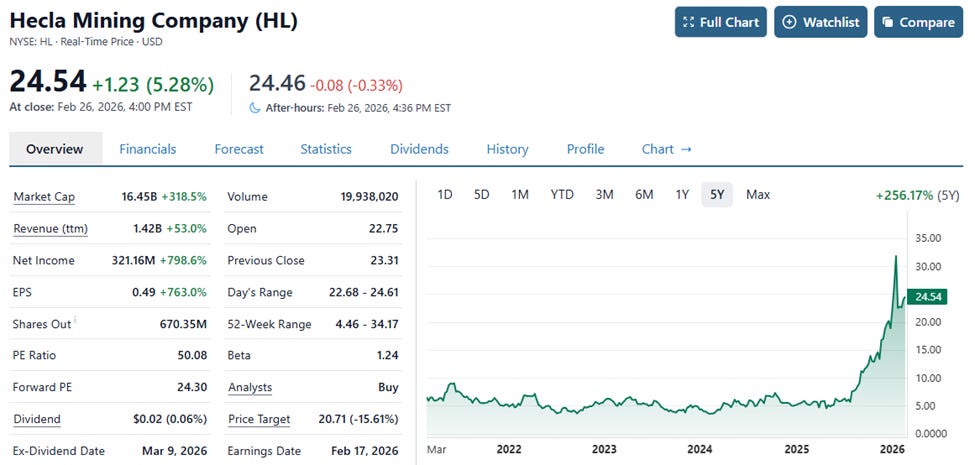
Hecla Mining (HL) is the 7th largest silver miner by market cap and is frequently grouped as one of Wall Street’s favorite silver mining companies.
What makes mining so complex is that many mining operations are located in countries with flexible relationships to property rights — they may seize assets or “re-negotiate” fees when it suits them. That’s what makes Hecla special: it’s a US-headquartered company with mines exclusively in the US and Canada, eliminating country risk.
Source: https://stockanalysis.com/stocks/hl/
The Fringe Finance Report first wrote about Hecla back in August 2025, when it was trading at around $7.50.

Hecla’s price chart looks like you missed the boat. But when you factor in how much gold and silver prices have risen since January 2025 and realize the Hecla stock has only captured about half that move, meaning many investors still seem to think the metal prices are temporary and will drop soon, and plus consider what further metal price gains would do to the Hecla share price on a P/E basis and FCF multiple basis, it’s easy to agree with Doug Casey who said about miners in general:
“Even after their recent run — two, three times up — they’re still at about the lowest level in history.”
Source: https://ffus.substack.com/p/legendary-speculator-doug-casey-the

Full Disclosure
I own Jan 2027 maturity call options that I purchased in 2025 when Hecla was trading at around $6, and I am still bullish.
Call Options
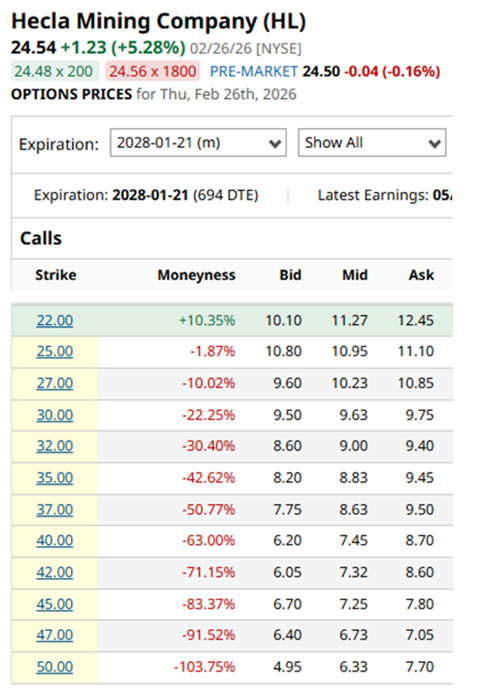
As of February 26, 2026, the longest maturity for exchange-traded call options on Hecla Mining (HL) is January 21, 2028—almost two years out. Hecla shares trade at $24.54. Here’s the leverage at that expiration:
At-the-money (ATM) calls at a $25 strike cost $11.10 each. This lets you control roughly 2x as many shares as buying stock outright.
Deep out-of-the-money (OTM) calls at a $47 strike cost just $7.05 each. This gives 4x leverage compared to buying shares.
Your choice depends on your silver price forecast and Hecla’s path by 2028.
Key caveat: Recent silver rallies have spiked implied volatility (IV), making options pricier. For context, I bought HL $12 strike calls when the stock was ~$6—costing $0.50/share for 12x leverage. Now, they’re costlier.
Warning: Options can expire worthless—you risk 100% loss. Only trade if you are experienced.
Hecla (HL) Call Option Prices at Various Strike Prices for January 21, 2028 Expiration as of February 26, 2026
Source: https://www.barchart.com/stocks/quotes/HL/options?expiration=2028-01-21-m&moneyness=5
We discuss the remainder of Chapter 4 and much more in the next chapters.
Remainder of Chapter 4: Major Silver Miners with Liquid Options (4 silver miners)
Chapter 5: Mid-Tier Silver Miners with Liquid Options (4 silver miners)
Chapter 6: Junior Silver Miners with Liquid Options (4 silver miners)
Chapter 7: Summary
Chapter 6 also includes a 200x opportunity as per legendary gold and silver investor and self-made billionaire Eric Sprott.